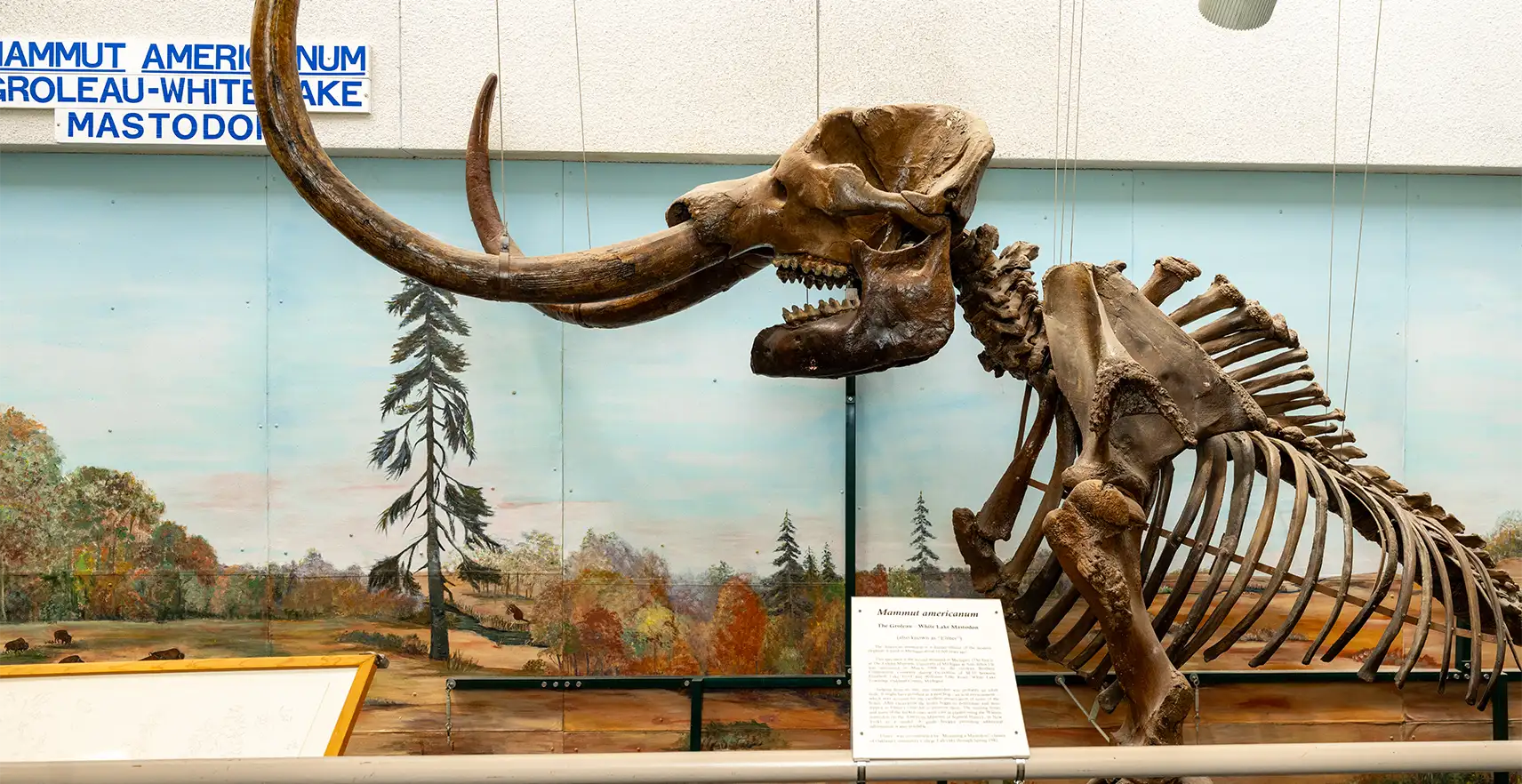
“Elmer” mastodon will soon have a new habitat thanks to a long-term loan
Cranbrook Institute of Science and Oakland Community College (OCC) announced today that OCC’s Groleau-White Lake Mastodon, nicknamed “Elmer,” will be transferred to Cranbrook Institute of Science under a long-term loan agreement. Elmer has inspired generations of OCC science students as a beloved fixture on the upper floors of Levinson Hall on the Highland Lakes campus.
Crews from Cranbrook Institute of Science will carefully disassemble Elmer and transport him to Cranbrook during the week of June 22, 2026. Following reconstruction work and preparation, the mastodon will go on public display as a centerpiece of a future exhibition anticipated to open in the summer of 2027.
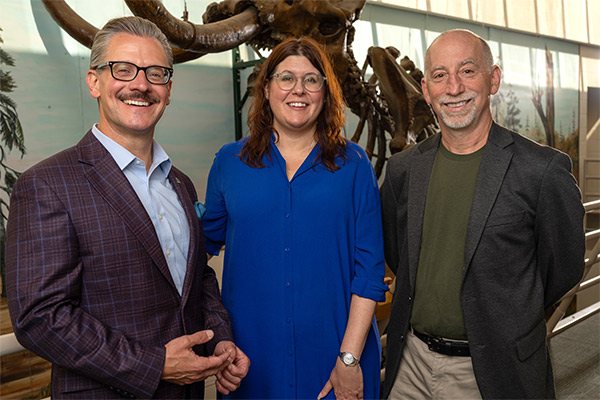
(L to R) OCC Chancellor Peter Provenzano, Cranbrook Institute of Science The Susan Flint Cooper Director Lucy Hale and Curator of Collections Cameron Wood standing in front of "Elmer” at the Highland Lakes campus.
"OCC has been proud to care for Elmer for nearly 50 years, and more people in our community, beyond our campus, should have the chance to experience him up close,” said Oakland Community College Chancellor Peter Provenzano, Jr. “Cranbrook partnered with OCC in the early 1980s when Elmer was reconstructed, so it’s especially fitting that we share a vision for his future. Through this partnership, families, students and the community will be able to visit Cranbrook’s Institute of Science to see what once roamed our local area and gain a fuller understanding of their role in Oakland County’s prehistoric ecosystem.”
“OCC’s mission is to empower our students to succeed and advance our community,” Provenzano added. “Now, Elmer will be able to do just that as he takes OCC with him and provides science education with greater reach.”
“This partnership allows us to preserve an important piece of Michigan’s natural history while expanding access to it for a broader audience,” said Lucy Hale, The Susan Flint Cooper Director of Cranbrook Institute of Science. “Elmer has inspired generations of students, and we are excited to continue that legacy at Cranbrook through new research, interpretation, and exhibition.”
“Relocating Elmer is more than a move—it’s the first ‘mammoth’ step in a growing partnership between our organizations,” added Provenzano. “We’re already exploring joint programming and other exhibits that will expand educational opportunities for the community.”
About Elmer
Elmer is the skeleton of an adult American mastodon (Mammut americanum) that lived more than 10,000 years ago during the late Ice Age. Discovered on March 11, 1968, by Groleau Brothers, Inc. during construction along M-59 between Elizabeth Lake and Williams Lake Road, the mastodon quickly became an important regional scientific find. The construction company donated both the bones and $500 to support their preservation.
Standing approximately 12 feet tall and measuring 22 feet long, Elmer would have weighed an estimated 5.5 tons in life. Today, the mounted skeleton weighs approximately 885 pounds. Mastodons were herbivores that fed primarily on leaves, twigs, and vegetation found in wet woodland environments.
About one-third of Elmer’s original bones were recovered, including the skull, ribs, vertebrae, scapulae, and large leg bones. Missing elements were meticulously reconstructed using casts made of plaster and fiberglass, including feet modeled after a mastodon specimen housed at the American Museum of Natural History in New York.
Elmer earned his nickname from the Elmer’s glue used during preservation to help stabilize his bones and prevent cracking—a practical solution that became a lasting piece of his identity.
“Moving Elmer will be a very delicate undertaking!” said Cameron Wood, Cranbrook Institute of Science Curator of Collections. “His unique suspended mount will require the Institute's team to proceed with great caution after reverse engineering how it was installed. Elmer's preservation, while current in the 1980's, has been replaced by more durable agents which may be employed once Elmer moves. Timing is excellent for Elmer's journey, as June's early-summer weather will minimize temperature and humidity fluctuations on the journey. Elmer's fossils are not heavily mineralized, as dinosaur bones tend to be. So, they are not nearly as heavy as dinosaur bones, and it preserves fragments of DNA, which in the future might assist researchers in the story of these bygone giants.”
A Unique Educational Legacy
Elmer’s reconstruction is a remarkable chapter in Michigan’s educational history. Beginning in September 1981, OCC students participated in a groundbreaking, hands-on course titled “Mounting a Mastodon,” led by Dr. Jeheskel (“Hezy”) Shoshani, a respected mammalogist and elephant expert.
Over the course of three academic terms, approximately 50 students contributed to the 10-month reconstruction effort, which was completed on June 24, 1982. Elmer was formally unveiled to the public just days later and has remained on display at OCC ever since.
The project also helped inspire future collaborations, including the 1983 “Dig a Mastodon” program—a joint initiative between Cranbrook Institute of Science, Wayne State University, and OCC that gave students hands-on excavation experience at a mastodon site in Brandon Township.
The Next Chapter
Elmer’s move marks the beginning of an extensive conservation and preparation process, leading to a major exhibition expansion scheduled to open in 2027. This next phase will expand opportunities for public engagement, scientific interpretation, and educational programming, bringing new depth and context to Michigan’s Ice Age story.
Once complete, Elmer will join Cranbrook Institute of Science’s existing mastodon, “Hezy,” a full-size replica named in honor of Dr. Jeheskel Shoshani. Hezy the mastodon, complete with a scientifically informed representation of fur and appearance, offers visitors a glimpse of what mastodons may have looked like in life.
The upcoming exhibition will place Elmer within a broader narrative of Michigan’s prehistoric past, highlighting Ice Age ecosystems, mastodon biology, and ongoing scientific research. More details about the exhibition will be announced in the spring of 2027.
Cranbrook Institute of Science has launched a crowdfunding campaign to help support Elmer’s continued preservation, research, and exhibition development. Supporters can play a pivotal role in bringing this important piece of Michigan history to life for future generations.
Additional Information
For more information and to support Elmer’s preservation, visit https://science.cranbrook.edu/elmer.
About Cranbrook Institute of Science
Cranbrook Institute of Science is a natural history and science museum that fosters in its audiences a passion for understanding the world around them and a lifelong love of learning.
Over 134,000 guests visit Cranbrook Institute of Science annually and another 40,000 throughout the region connect via well-developed and highly regarded outreach programs. Cranbrook Institute of Science boasts a collection of more than 250,000 objects from around the world; including an extensive collection of objects from Michigan.
Visitors to Cranbrook Institute of Science experience interactive exhibits, a world-class collection of objects and artifacts, a full-dome planetarium, and a research-quality observatory.
Cranbrook Institute of Science is a part of Cranbrook Educational Community; a 501(c)3 non-profit whose National Historic Landmark campus also includes Cranbrook Academy of Art, Cranbrook Art Museum, Cranbrook Center for Collections and Research, Cranbrook House & Gardens, Cranbrook Schools, and other affiliated cultural and educational programs.
Cranbrook is located at 39221 Woodward Avenue, Bloomfield Hills, MI 48304.
To learn more about Cranbrook Institute of Science, please visit https://science.cranbrook.edu.
About Oakland Community College
Oakland Community College (OCC) has educated over one million students since 1965. OCC offers more than 80 degree and certificate programs and is committed to student success with affordable tuition, support services, flexible class options and top transfer opportunities. The College serves more than 20,000 students annually while advancing our community through education, training and career support. OCC is nationally recognized as Michigan’s top online college, and seventh in the U.S., by Newsweek’s America’s Top Online Colleges 2025. Learn more at oaklandcc.edu.
Media Contacts
Kim Madeleine
Media Relations Lead
Oakland Community College
Phone: (734) 765-6321 | Email: [email protected]
Eric Franchy
Director of Marketing & Communications
Cranbrook Institute of Science
Phone: (248) 645-3162 | Email: [email protected]
###